HBCU ORIGINAL
Antwain Banks’ Fourth Quarter Touchdown Sparks Bowie State, but Davenport Holds on for a 17-14 Win

Bowie, MD – In a game dominated by defense, the Davenport Panthers narrowly escaped with a 17-14 victory over the HBCU Bowie State Bulldogs on Saturday afternoon at Bulldog Stadium. The win moves Davenport to 2-0 on the season and improves their record against the Bulldogs to 2 0.
The Panther’s first score on their second drive came off Brandon Gielow‘s foot when he successfully drilled a 42-yard field goal to give DU the first lead of the game, 3-0. From there, Davenport would control the momentum of the game when, in the second quarter, Mike O’Horo connected with Preston Smith on a fade route in the back of the end zone for the touchdown, making it 10-0.
Bowie State would respond 2 minutes before the half late in the second quarter. After a crucial stop by the Bowie Defense, Kevin Taylor‘s 11-yard drive would cap off an eight-yard touchdown pass to Awesome Waller, Jr., bringing the score to 10-7. However, Davenport struck back right before halftime when O’Horo found Antjuan Collins near the three-yard line, and after a quick juke, Collins took it into the end zone to give the Panthers a 17-7 lead at halftime.
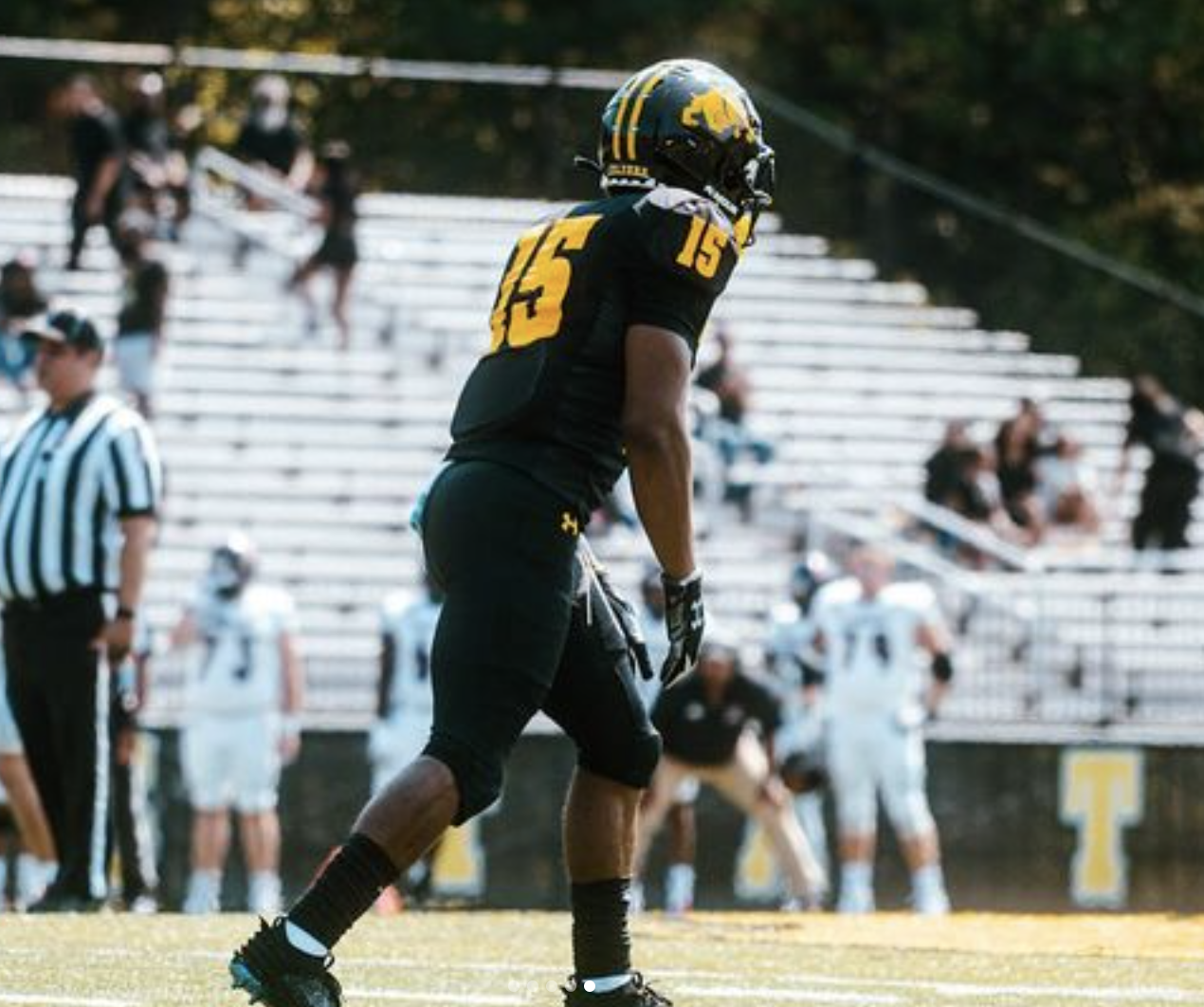
The second half became a defensive showdown, with both teams struggling to capitalize on long drives. Bowie State finally broke through at the start of the fourth quarter when Taylor launched a 30-yard touchdown pass to Antwain Banks, who debuted for the Bulldogs after transferring from Lincoln University. This score narrowed the deficit to 17-14 and gave Bowie State hope for a comeback.

Why Antwain Banks’ Impact and the Story Is Important.
As a Maryland high school standout at quarterback, Bank was a dynamic quarterback at Edgewood High School in Edgewood, Maryland. Despite his success as a state leader in high school, college programs didn’t know what to do with him, leaving him under-recruited and without offers until just before graduation, when Frostburg University extended an offer to play quarterback. Ironically, he only played quarterback in high school after the starting QB transferred in the middle of his junior year at Edgewood. As the most dynamic athlete on the field, initially playing slot receiver, he stepped into the quarterback role because there were no other viable options. He took on the challenge, hoping colleges would recognize how explosive and versatile he was with the ball in his hands.
Despite his remarkable stats as a dual-threat quarterback, rushing for over 4,000 yards and 46 touchdowns during his sophomore and junior seasons, he led the state in rushing both years, ranking first in touchdowns his junior year and finishing second in touchdowns his senior year.
High School Honors:
- 1st in state for scoring & touchdowns (26) in 2018
- 2nd in state rushing (131 ATT | 1,686 YDS) in 2018
- 5th in state total yards (2,498) in 2018
- 1st in the 3A division for total yards in 2018
- 1st in 3A rushing (126 ATT | 1,544 YDS) in 2017
- 1st in 3A division touchdowns (20) in 2017
- 1st in 3A division total yards (2,629) in 2017
- All-Metro mention, All-Conference, and All-County
Collegiate Honors:
- Dean’s List with a 3.8 GPA in 2022
- All-Academic Team with a 3.38 GPA in the 2023 slot as a redshirt freshman receiver
After redshirting at Frostburg, he transitioned to slot receiver at HBCU Lincoln University in Pennsylvania. Earning a starting position at Lincoln, he soon realized he could better showcase his talents in a more competitive program. This led him to transfer to Bowie State during his sophomore redshirt to pursue a starting role. Banks’ journey to Bowie State is one of perseverance as an under-recruited athlete out of high school. His performance on Saturday—two catches for 57 yards and a touchdown—showed the value of athletes who may have been overlooked but possess the talent to make an impact.
Banks’ story mirrors that of his cousin, Deonte Banks, who also faced limited recruiting opportunities before earning a late scholarship offer from the University of Maryland. Deonte would be a first-round draft pick for the New York Giants, proving that under-recruited athletes can defy expectations when given the chance. Athletes like Antwain Banks are often overlooked by major programs due to their lack of star ratings and limited visibility in their high school markets, often because they come from more rural areas. Factors like a lack of recruiting networks among coaches and outdated recruitment philosophies also contribute to their underexposure. With the rise of social media, some recruiting budgets are being cut as recruiters rely more on online data. Colleges now prefer athletes to come to them through unofficial visits, mega camps, junior days, and game day experiences rather than actively scouting them in person.
Antwain demonstrated talent and knows no ranking. These athletes find ways to contribute at all levels of college football, often walking on or transferring to programs where they can showcase their skills. The Under Recruited Athlete platform exists to highlight these stories, ensuring that athletes with similar paths to Banks have opportunities to be seen and scouted by college programs.
Bowie State showed resilience and heart despite the loss, especially from players like Antwain Banks, whose story embodies the spirit of underrecruited athletes across the country. As college programs look to strengthen their rosters, Banks’ performance is a reminder of the untapped potential in athletes who may not have received high recruiting attention but are fully capable of impacting the field.
HBCU ORIGINAL
Saint Augustine’s Files Chapter 11 — A Legacy Institution at a Crossroads
A historic HBCU is now in the fight of its life.
Saint Augustine’s University has officially filed for Chapter 11 bankruptcy, marking a defining moment not just for the school—but for the future of smaller HBCUs across the country.
The Breaking Point
According to recent reporting from WRAL, the university filed for bankruptcy protection on April 27, 2026, as it faces overwhelming financial pressure, mounting debt, and ongoing operational instability.
This move allows the university to restructure what has been described as a severe financial crisis—one that includes tens of millions owed to creditors and government agencies.
But this wasn’t sudden.
Years of financial strain, leadership turnover, and declining enrollment created a slow-building collapse that has now reached a critical stage.
Accreditation Crisis Made It Worse
One of the biggest blows came in 2025, when the university lost its accreditation battle. Without accreditation, access to federal financial aid becomes uncertain—cutting off a major pipeline for student enrollment and revenue.
Even with temporary legal relief at one point, the long-term damage had already been done.
Now, with bankruptcy in play, the road back becomes even more complicated.
What Happens to Students?
This is where the story hits hardest.
- Seniors are expected to graduate if they’re close to completion
- Other students may be forced into transfer or “teach-out” agreements
- The university has discussed shifting toward certificate and non-degree programs during recovery
The reality: students are caught in the middle of an institutional reset.
Not Just One School — A Warning Sign
Saint Augustine’s isn’t alone—it’s just the latest.
Across the HBCU landscape, especially for smaller private institutions, there are growing challenges:
- Declining enrollment numbers
- Rising operational costs
- Limited endowments
- Heavy reliance on federal aid
Saint Augustine’s situation highlights how quickly things can shift when multiple pressures collide.

The Cultural Impact
Let’s be clear—this isn’t just about finances.
HBCUs like Saint Augustine’s were built to educate Black students when no one else would. Founded in 1867, the institution has served generations of first-generation college students and produced leaders across industries.
When an HBCU struggles, it’s not just a campus at risk—it’s legacy, access, and opportunity.
What Chapter 11 Really Means
Chapter 11 is not closure—it’s a lifeline.
It gives the university a chance to:
- Restructure debt
- Stay operational (for now)
- Attempt a long-term rebuild
But there’s a major obstacle: institutions in bankruptcy typically face restrictions around federal funding, making recovery extremely difficult.
Translation: this is a long road, not a quick fix.
What Comes Next
Right now, Saint Augustine’s future is uncertain.
The university must now prove it can:
- Stabilize leadership
- Rebuild trust
- Secure funding
- Regain accreditation
That’s not easy—but it’s not impossible.
HBCU Original Take
This moment is bigger than one campus.
It’s a reminder that:
HBCUs are essential—but not invincible.
The question moving forward isn’t just whether Saint Augustine’s survives.
It’s whether enough attention, investment, and support will come in time—not just for this institution, but for others quietly facing the same pressures.
Because protecting HBCUs means protecting the pipeline of Black excellence.
Events
Ceasefire Declared: Trump Backs Down from “Total Destruction” Threat as Iran Deadline Passes
In a dramatic shift from the brink of catastrophic escalation, President Trump announced a two-week ceasefire with Iran on Tuesday, hours before a midnight deadline that threatened the total destruction of Iranian national infrastructure. The pause in hostilities follows an intense period of military strikes and an international outcry over the President’s rhetoric.
From Ultimatum to Ceasefire
Earlier on Tuesday, the situation reached a fever pitch when President Trump warned that “a whole civilization will die tonight” if Iran did not meet his demands to reopen the Strait of Hormuz—a vital global energy artery. The President had explicitly threatened to target civilian infrastructure, including every bridge, power plant, and water treatment facility in the country, a move legal experts warned would constitute a war crime.However, by late afternoon, a stark reversal was announced. The two-week ceasefire, brokered in part through diplomatic efforts in Pakistan, is contingent on Iran opening the Strait and adhering to specific terms to de-escalate the U.S.-Israeli bombing campaign.
Domestic and International Reactions
The President’s threats sparked a firestorm of condemnation in Washington. House Minority Leader Hakeem Jeffries (D-N.Y.) called the rhetoric “unhinged,” while other Democratic lawmakers, including Rep. Ayanna Pressley (D-Mass.) and Rep. Pramila Jayapal (D-Wash.), characterized the proposal as “genocide” and called for the President’s removal from office.While most Republicans remained supportive of a “strong” approach, some, like Rep. Nathaniel Moran (R-Texas), broke ranks to condemn the threat against an entire civilization. International leaders and human rights organizations also voiced grave concerns over the potential for massive civilian casualties.
Developments on the Ground
Despite the ceasefire announcement, Tuesday began with significant military activity:
-
Kharg Island: U.S. forces conducted “restrikes” on military targets at Iran’s primary oil export hub.
-
Civilian Defiance: In Tehran, Iranian officials and citizens staged demonstrations near power plants, vowing to act as human shields to protect public infrastructure.
-
Casualties and Displacement: The conflict has already taken a heavy toll, with over 1,900 people reported killed in Iran and more than 1,400 in Lebanon.
The Path Forward
The two-week window provides a narrow opportunity for diplomacy. Iran’s 10-point proposal for a permanent peace includes guarantees against future aggression and an end to Israeli strikes in Lebanon. While the ceasefire brings a temporary reprieve to the region, the situation remains “critical and sensitive” as both sides weigh their next moves in what has become the most significant military conflict of the Trump administration’s current term.
Events
Southern Royalty Meets Hip-Hop Heritage: T.I. Enlists Tuskegee’s Marching Crimson Pipers for ‘Trauma Bond’ Visuals
In a powerful collision of Southern hip-hop and HBCU excellence, Atlanta icon T.I. has released the official music video for “Trauma Bond,” featuring the legendary Tuskegee University Marching Crimson Pipers.
The collaboration serves as a centerpiece for the rollout of T.I.’s twelfth and final studio album, Kill The King. Rather than opting for traditional music video tropes, the “King of the South” chose to highlight the discipline, pageantry, and cultural weight of one of the nation’s most storied HBCU band programs.
A Cinematic Tribute to HBCU Culture
Directed by visionary filmmaker Chris Robinson—marking a high-profile reunion with T.I. exactly 20 years after their cult-classic film ATL—the video was shot in the historic “Bluff” neighborhood of Atlanta. The visuals capture a striking contrast: the raw, introspective energy of T.I.’s lyrics set against the sharp, synchronized precision of the Crimson Pipers.
The choice of Tuskegee is far from coincidental. The track, produced by Mr. Hanky, is built on a triumphant, cinematic foundation that mirrors the “showtime” energy of an HBCU halftime performance. For Tuskegee alumni and fans, the sound is instantly recognizable, as the production samples the spirit of the band’s iconic anthem, “Ball N’ Parlay.”
The ‘Ball N’ Parlay’ Connection
By integrating the Marching Crimson Pipers, T.I. taps into a deep-rooted Southern tradition. “Ball N’ Parlay,” originally a 1999 track by the late Houston rapper Big Pokey, has become the unofficial heartbeat of Tuskegee’s campus life. Seeing the band bring that same energy to a mainstream global platform reinforces the immense influence HBCU bands have on modern music production and aesthetic.
The Final Chapter: Kill The King
“Trauma Bond” represents a significant shift from T.I.’s previous high-energy single, the Pharrell-produced “Let ’Em Know.” This latest release offers a more vulnerable look at loyalty, street ethics, and the psychological “bonds” formed through shared struggle.
As T.I. prepares to retire his musical persona to focus on his expanding business empire, the inclusion of an HBCU institution like Tuskegee feels like a deliberate move to cement his legacy within the community. It isn’t just a music video; it’s a full-circle moment for Southern culture—honoring the institutions that have provided the soundtrack to the South for generations.
Original reporting based on coverage by Anaya McDonald for Black Enterprise and DJ Pup Dawg for iHeartRadio.
HBCU ORIGINAL
The Echo of a Nightingale: Remembering Carrie Everett’s Historic Reign and Final Act of Courage
The Queen of the People: The Brief, Brilliant Reign of Carrie Everett
In the history of the Miss North Carolina pageant, a crown has been many things: a prize, a burden, a tradition. But in the hands of Carrie Everett, the crown became a catalyst.
Everett, a 22-year-old student at North Carolina Central University (NCCU), didn’t just win a title; she shattered a glass ceiling that had stood for nearly nine decades. On Easter Sunday, 2024, the world learned that this pioneer—the first woman to win the Miss North Carolina title while attending a Historically Black College or University (HBCU)—had passed away after a valiant battle with a rare and aggressive form of gastric cancer.
A Victory Built on Faith and Forty Dollars
Carrie Everett’s story is a modern-day fable of resilience. A native of Seattle, Washington, she arrived in the pageant world not with a team of consultants or a massive wardrobe budget, but with a voice trained in the gospel tradition and a spirit that refused to be intimidated.
Her journey to the state title was famously grassroots. Entering the circuit with just $40, Everett relied on borrowed gowns, thrifted accessories, and an unwavering belief that her worth was not defined by her wealth. When she was crowned Miss North Carolina 2024, she became only the fourth Black woman to hold the title in the pageant’s 87-year history. More importantly, she proved that the “Eagle Excellence” of NCCU belonged on the national stage.
The Platform: Equity Over Optics
Everett’s platform, “We Need Equity to Build Communities,” was more than a slogan; it was a reflection of her own struggle. Having faced the high financial barriers of the pageant world, she dedicated her reign to making these opportunities accessible to young women from lower socioeconomic backgrounds.
She used her position to bridge the gap between the prestige of the Miss America organization and the grassroots talent found within HBCUs. As a vocal performance major, she didn’t just speak about change—she sang it. Her “nightingale” voice became a staple at university events and state functions, a melodic reminder of the grace she carried even as she navigated the pressures of being a “first.”
The Final Battle
The trajectory of Everett’s life took a devastating turn in July 2025. She was diagnosed with metastatic signet ring cell carcinoma, an incredibly rare and fast-moving form of gastric cancer.
For many, such a diagnosis would have led to a quiet retreat. For Everett, it was a final opportunity to lead. Even as she underwent grueling treatments, she remained vocal about her journey. She spoke of her diagnosis not as a tragedy, but as a “purpose,” telling reporters that God had given her a voice to speak for those who felt unheard in the healthcare system.
Her passing on Easter Sunday 2026 brought a wave of mourning across North Carolina and the HBCU community. NCCU Chancellor Dr. Karrie Dixon remembered her as a “trailblazer” who embodied the highest ideals of the university.
An Enduring Legacy
Carrie Everett’s reign was short, but its impact is permanent. She changed the visual language of North Carolina pageantry, ensuring that future HBCU students would see themselves in the crown. She leaves behind a legacy that emphasizes substance over style and equity over exclusivity.
Though the “beautiful nightingale” has fallen silent, the doors she opened remain wide. Carrie Everett did more than win a pageant; she redefined what it means to be royalty—proving that the truest crown is the one earned through service, sacrifice, and an unbreakable spirit.
Original reporting by Anaya McDonald, Black Enterprise.
HBCU ORIGINAL
🏈 HBCU Prospects Push for Draft Spotlight at First-Ever NFL Combined Showcase
By Tamara Brown
With no HBCU players invited to the 2026 NFL Scouting Combine, a group of 48 standouts took matters into their own hands—using the league’s newly expanded showcase to make one final push toward the NFL Draft.
Held at the Washington Commanders’ training facility in Ashburn, Virginia, the event marked a historic first as the NFL HBCU Showcase merged with the International Player Pathway Pro Day, creating a unified platform designed to elevate overlooked talent.
For HBCU prospects, the stakes couldn’t be higher.
Over the past three years, only two HBCU players have been selected in the NFL Draft, and with no active HBCU invitees to this year’s combine, opportunities to impress scouts are limited. That reality makes showcases like this one critical—offering a direct pipeline to NFL and CFL personnel evaluating talent up close.
This year’s event brought together talent from across the MEAC, SWAC, CIAA, and SIAC, featuring names like Noah Miles (Howard), Walker Harris (North Carolina Central), Quincy Ivory (Jackson State), and Erick Hunter (Morgan State). The field also included top Division II talent, including Virginia Union running back Curtis Allen, the reigning DII Player of the Year.
But one name stood above the rest.
Morgan State linebacker Erick Hunter delivered a combine-level performance that turned heads across the league. At 6-foot-2 and 224 pounds, Hunter clocked a 4.48-second 40-yard dash, a time that would have ranked among the best at his position in Indianapolis. He also posted a 10-foot-10 broad jump and a 37-inch vertical, showcasing elite explosiveness and athleticism.
Other standouts made their mark as well. Jackson State’s Donerio Davenport and Benedict’s Jamal Sam both posted blazing 1.56-second 10-yard splits, while Florida A&M offensive lineman Ashton Grable powered his way to the top of the bench press leaderboard with 28 reps.
Beyond the numbers, prospects also participated in position drills and interviews with NFL and CFL personnel—critical moments that could determine futures at the next level.
As evaluations continue, all eyes now turn to the 2026 NFL Draft, set for April 23–25 in Pittsburgh. For many of these athletes, Ashburn may have been the moment that changed everything.
-
HBCU ORIGINAL2 months agoSUNO Wins First Conference Title Since 2012
-
HBCU ORIGINAL2 months agoMorehouse Captures SIAC Championship, Tops Tuskegee 66–56
-
HBCU ORIGINAL2 months agoMiles Lady Bears Complete Historic Three-Peat with SIAC Tournament Victory
-
HBCU ORIGINAL2 months agoTennessee State Ends 30-Year Wait, Dominates Morehead State for 2026 OVC Title
-
HBCU ORIGINAL2 months ago🏀 Broncos’ Season Ends in NCAA Regional Loss Despite Double-Double Performances
-
HBCU ORIGINAL2 months agoHoward Women Capture MEAC Championship, Defeat Norfolk State 53–46
-
HBCU ORIGINAL2 months ago🏀 Lady Rams Fall in Heartbreaker in Atlantic Regional Championship
-
HBCU ORIGINAL3 weeks ago🎾 Tuskegee Dominates SIAC Tennis Honors with Undefeated Momentum